Tuesday, November 2, 2010
Magic Carpet
Wednesday, October 27, 2010
If words can’t express one’s thoughts, how can they express one’s pain?
A person’s pain cannot be fully comprehended or explained simply through words. The words have to posses the ability to invoke feeling in the listener. However, even though the listener may hear the words being expressed, they are not able to fully comprehend the meaning behind them. Granted there are doctors trained in fields of science to help people cope with their pain; but the amount of physical, emotional, and psychological pain endured is far too great. These doctors sift through the victim’s mind and pick out the things he or she thinks is important in helping the victim cope. Elaine Scarry, explains that “physicians do not trust the human voice…they in effect perceive the voice of the patient as an ‘unreliable narrator’ of bodily events, a voice which must be bypassed as quickly as possible so that they can get around and behind it to the physical events themselves”(The Body in Pain The Making and Unmaking of the World). In other words, physicians often request a verbal explanation from the patient, but only does so to allow the patient to feel they have given an accurate explanation of there pain. However, the physician accepts the explanation and now purges further to uncover the root of the victim’s pain.
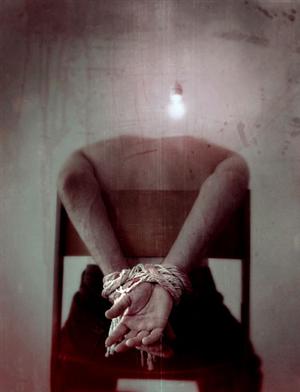
The initial reaction to bondage and torture is fear. In the case of modern day slavery, fear of torture and the tormentor is what fuels the pain. There is fear of the unknown, which is a natural human response to discomfort. By being enslaved, slaves are victims of torture as well as psychologically disturbed. Once the tormentor or slaveholder invokes that fear, psychologically, the victim is not able to escape. They may physically become free, but will always be held captive in their minds. Doctors such as Dr. Vaknin, the author of Malignant Self Love Narcissism Revisited, states: “Torture robs the victim of the most basic modes of relating to reality…Torture has no cut-off date. The sounds, the voices, the smells, the sensations reverberate long after the episode has ended”(The Psychology of Torture). Torture prolongs fear and causes it to be ever-present. With victims of slavery, the torture is so extreme it constantly haunts the slave.
Repression is a tactic that many victims of slavery use to try and remain sane. The act of repression is burying a memory deep into one’s brain in an effort to forget. Although this is true, there are things that will trigger the memory and send the person back in to that former state of fear. The memory that person has will never be erased and has had far to great of an impact to be forgotten. For instance, in the case of the brothel mother Katarina ("DMS"), she was once involved in sex work but later took part in running the brothel. This exemplifies the toll that being a sex worker took on her. She believed that " the brothel is simply a second home where young women come to make money" (DMS).
Even though victims struggle daily with fear, there are outlets to express this pain other than language. Because pain and fear can’t justly be vocalized, victims have the option of expressing their pain through artwork, theatre, music and drama. By channeling these negative feelings into something positive, they can even create pieces of work that inspire others. This is a form of positive reinforcement that allows for an action to be repeated thus giving the victim a way to overcome what happened to them. As with James Kofi Annan in “DMS”, he fueled his “anger” of being enslaved into education. He was determined to become the best pupil and rose to the top of his class. However, even after such an accomplishment, he was still psychologically tormented by the events of being enslaved. This is a small step, but he stated that by helping others, he is slowly helping himself along the road of rehabilitation. Other slaves who find themselves free and the verge of recovery can take on this challenge of bettering themselves through helping others or through expressive forms of art.
-Raney Antoine & Jessiona Bryant
Wednesday, October 20, 2010
REHABILITATION IS CRUCIAL
Debt bondage
Imagine this, you are doing your best to raise and provide a good life for your children but each day is a struggle. One day you hear that you can provide a better life for them in a different country. Great right? The only problem is; how are you going to get into that other country? From a source you hear that there is a man who is from this different country and he can get you and your family over there! So you seek out this man and he tells you that he will do the job, so you put your trust in him and once your family is in this new country the man tells you that it took a lot of money to get you into the country and that he wants it back. The only option he gives you is to work for him and repay your debt or he will call the immigration services.
Slavery is wrong in all aspects, but still some forms of slavery may be avoided. Although for some people it is hard to avoid being exploited, many have the option of choosing a different lifestyle. However the people who fall into the category of being in bonded labor may never escape. Debt bondage is considered by many to be a modern day form of slavery, and it affects many people as well as their families all over the world. A person becomes in bonded labor when they are being forced to pay off a loan through physical labor. The person in debt may be tricked or trapped into working for little to no money, and the value of their work is significantly greater than the original sum of money borrowed. Poverty, lack of education, and violence from their captors is what keeps most people in bonded labor. Governments in the area where this is prevalent make no effort to enforce laws even though this is illegal worldwide. It has gotten so bad that many children are born into the debt that their family owes, and these children end up living their lives trying to pay off a debt which in many cases have accumulated interest. Also due to a need for cheap labor, cases of debt bondage are increasing! According to the online antislavery organization “Today the international Labor organization estimates a minimum 9.3 million are in forced labor in the Asia pacific region, the majority of whom are in debt bondage.”
The question is why is slavery still going on in this modern day society? My argument is that this form of slavery is not fair to the many people who just wanted to provide a better life for their children. Also we need more organizations to help do something about this unnecessary form of exploitation. The fact that debt bondage is increasing is horrible and many people need to become aware of this. That is why it is important to educated people from all over the world. Maybe then will modern forms of slavery decrease or be gone forever.
Wednesday, October 13, 2010
Child Soldiers
The problem of child soldiers is most critical in Africa, where children as young as nine have been involved in armed conflicts. These armies use child soldiers because they are cheap, and easy to manipulate. "Their underdeveloped ability to assess danger means they are often willing to take risks and difficult assignments that adults or older teenagers will refuse." These children are forced to commit unthinkable crimes, and once they are rescued or escape, "face an enormous challenge in trying to return to normal civilian life."
Whether these children are abducted or become soldiers of their on free will, should we view them as victims even though they have committed so many horrible crimes? Should they receive mercy? Should the reasons behind them joining grant them mercy or make them a victim? These children should be viewed as victims and given mercy. "Child-soldier expert Michael Wessells told Vision that no choice is a “free choice” because it is typically grounded in dire circumstances, including poverty, starvation, separation from their families, physical or sexual abuse, or lack of livelihood or education." These children join because they have no other choice. In A Long Way Gone: Memoirs of a Boy Soldier an autobiography by Ishmael Beah, he tells us how he was "separated from his family when their village was attacked by rebel forces, for a while he avoided abduction into the armed conflict that enveloped his country. Eventually, however, hunger and insecurity led him to join the government forces, who compelled him not only to fight against the rebel opposition but to perpetrate acts of extreme violence against innocent civilians along the way."
These children should not be at fault for what they have done because it was out of their control. Organizations such as, Amnesty International, The Committee on the Rights of the Child (CRC) and UNICEF, draw attention to this problem and help children who become child soldiers. No child should have to become a child soldier, or be kidnapped from their families and forced to become one. These children should have a normal childhood but instead it is tainted with blood, and the horrible crimes that they must live with for the rest of their lives.
Unholy Matrimony
Programs like the Institute of Health Management Pachod, work in countries like India, and provide skills and education for these young girls. Programs like this are helpful, because most of these girls have only up to a fourth grade education. Anju Malhorta, vice president of the International Center for Research on Women, finds that many girls and parents that live in communities where child marriage is common want to delay the age to eighteen, but lack the resources. Anju Malhorta also believes international donors could improve effectiveness of aid money integrating child marriage prevention into current development initiatives, ensure the health and survival of infants, and most importantly, invest in girls’ education.
This topic raises a question that we all should ask, is this really slavery? The dictionary definition of slavery is the state or condition of being a slave; a civil relationship whereby one person has absolute power over another and controls his life, liberty, and fortune. Slavery? You decide.
Tuesday, October 12, 2010
Slavery: A Tragic Recipe for World Domination
The following story is a fictional representation of what slaves have provided for the United States, the world’s most powerful nation:
There are twenty students in Mr. Sam’s math class. Out of the twenty students, only two of them are smart enough to pass the class, which is a requirement for graduation. The rest of the class is full of slackers who are willing to do anything other than the work itself to avoid failing. The lazy students understand that graduation is in jeopardy, so they devise a scheme that will ensure their success. Unfortunately for the two ambitious students, the plan revolves around them doing everyone else’s work. They are oblivious to the scheme until one day after class, when the slackers take them by surprise and beat them senseless in an abandoned parking lot. The slackers impose their will on their defenseless classmates beyond the point of surrender. Scared for their lives, the ambitious students agree to do homework and projects for the rest of the class.
As time progresses, the good students continue to do work for the everyone else. Their peers’ work is now their main priority due to the brutality they may otherwise encounter, and they have no time to do their own assignments. While their grades are plummeting, the slackers’ grades are skyrocketing. In the end, the abusers graduate the class and move on to bigger and better things, and the students responsible for the others‘ success, become failures themselves.
This is a portrayal of how historical slavery built the United States' economy. However, due to the brutal mistreatment of slaves, people don't often refer to free labor as the most profitable practice in history. It's important that americans, african americans especially, understand the impact that their ancestors had (and still have) on the world's greatest superpower. It is blatantly unfair for slave owners to reap the benefits of slave labor without properly crediting the workers themselves. Awareness needs to be spread regarding the impact of slaves on the united states economy, so perhaps they can finally be 'paid back'.