Wednesday, October 5, 2011

Kids or Killers?


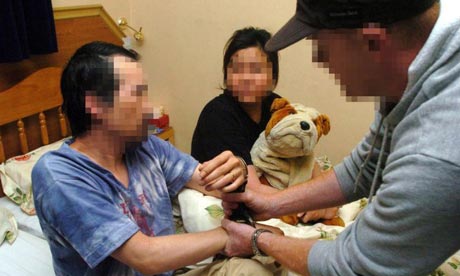
The methods used to train child soldiers turn them into killers through great manipulation; although rehabilitation programs are the only way to attempt to reintegrate these children into society, the people recruiting them must be stopped to end the vicious cycle. From the moment a child is chosen to fight in war, he/she is forced to face death with utter insensitivity. When a child is taken from their home to become a soldier, their families are often killed right in front of them; this is a way for the commanding officers to obtain total control. One of the first few steps in training a child to fight usually involves having the child kill someone; this person is often a civilian or someone from the child’s village. Killing someone from their village ensures that the child will not try to escape, for they will no longer be welcomed at home. It is common for the child to then have to consume the flesh or blood of the person they have killed, in an effort to diminish their emotional reaction to death.
Evidently, after this process the children are killers; they now see killing as a solution to most problems and have no emotional reaction to the crime they are committing. A child soldier, whos name was anonymously recorded as M, was quoted saying, "When I was fighting, I enjoyed it- killing and destroying. I killed human being, many; young, old, anyone. The first one, an old lady, I shot from far away. I was very angry, so I shot her. Their families killed my people" (Children At War). Although the children affected did not choose to be murderers, they are nonetheless a threat to society once returned to their normal lives. The rehabilitation programs and laws in place to protect children are not aggressive enough to put an end to this issue. Most of the rehabilitation programs in place by the United States in other countries require the children to want to willingly go through the rehabilitation process. Also, with the high possibility of children being sent back into war, they are only helped temporarily before being placed back into this vicious cycle.

Photo credit

http://childsoldierrelief.org/laws_treaties/
http://www.vision.org/visionmedia/article.aspx?id=6684
Singer, P. W. Children at War. New York: Pantheon, 2005. Print.

Sunday, October 2, 2011

The Code of Lekë Dukagjini


Nations, like Albania, still employ laws set during ancient times. These laws are sexist, abusive, and unfair to its citizens, especially women. In “Sex Trafficking: inside the business of modern slavery,” written by Siddarth Kara, he explains that Albanians are still ruled by the Code of Lekë Dukagjini, which was written in the 1400s, by Kanun I Lekë Dukagjinit. It’s laws are based on honor. This, however, is biased against women, who according to this law, are subordinate to men. The code states, “The blood of a woman is not equal to the blood of a man. A woman is known as a sack, made to endure.”

This code makes life extremely difficult for females. Kara, states the code “renders life extremely difficult for unmarried women.” (Kara, 7) He goes on to say that in some cases, family members sell each other as sex slaves, as was the case with Pira, a former sex slave. He writes, “A former sex slave named Pira told me that the night she was married, her husband sold her to the owners of a sex club, where she was forced to have sex with hundreds of men before she escaped.” (Kara, 7) This code accentuates the roles of males and females in rural Alabania. A wife’s duties to her husband primarily center around complying to his demands, and fulfill her marital duties. An article in The International Herald Tribune depicts women’s roles as caring for the children and maintaining the home, along with all the other conjugal duties she must face. (Bilefsky, 2008) Whereas, the husband’s only duty to his wife is to provide clothing and shoes and to preserve her honor. The wife, by no means, may complain to her husband about her responsibilities. Furthermore, if her husband wishes to divorce her, he has the right to cut off her hair, strip her nude and take her away from her relatives, expelling her from her village with a whip. This form of abuse is seen in Albania and women endure this type of injustice to this day, all because of an ancient, cruel code. Through the years, though, the code has lost some influence. Life is not structured around this code as strictly as it once was. The code is almost nonexistent in developed cities, but that is not the case in the rural communities.
The struggle these women face is so brutal and excrutiating that one of the options the Code of Lekë Dukagjini gives women in order to liberate themselves from the oppression of marrying, is to undergo a sex change, and swear an eternal oath of celibacy. With this promise, these women, now converted men, can live their lives and rule their families as males. It is unfortunate, however, that they have to surrender being who they are and take on completely new lives, just because society dictates it.

In order for rural Albanians to move away from this lifestyle they should observe their neighbors of the developed cities. With their influence they might be able to organize and unite to put an end to this vile code. I strongly believe that once they begin to organize and make strides to bring about change, other nations and humanitarian organizations will jump in to join their fight to bring justice to all members of the community and not just a select few. It is encouraging to see major news outlets, like The International Herald Tribune, a member of The New York Times Media Group, making room in their publication to shed light on this issue. The more people know about this issue, the more influence the people of Albania will have, since they will have the backing of the international community.

links: http://heinonline.org/HOL/Page?handle=hein.journals/eccc14&div=15&g_sent=1&collection=journals
http://www.mapsofworld.com/images/world-countries-flags/albania-flag.gif
http://books.google.com/books?hl=en&lr=&id=WWb-wx1gjLwC&oi=fnd&pg=PR7&dq=sex+trafficking:+in+the+business+of+modern+slavery&ots=Rx5Gs7wOIj&sig=J_V5RabvqBOCOA6K9z6gbb55BxE#v=onepage&q=sex%20trafficking%3A%20in%20the%20business%20of%20modern%20slavery&f=false

Wednesday, September 28, 2011

Traffickers = Monsters?


Human trafficking today has become a serious global issue. Despite the fact that slavery is legally banned in every country in the world, experts are claiming that there is a range of 10-27 million slaves worldwide. This number is not only including slaves used for sexual services, but for mining, agricultural, domestic, factory work etc. We know that the lives of these unfortunate people are harsh and demeaning. Their stories of survival break our hearts and make us feel ashamed that modern-day humans can be this cruel. They embarrass us because our utter lack of knowledge and awareness on such a large, horrendous industry is revealed. But what do we really know about those particular people who are doing the trafficking? Sure we know what signs to look for to avoid a trafficking scam and how the traffickers operate, but there is more to the story. How do traffickers get into this line of business? What aspect of this lifestyle draws them in and keeps them hooked?

Since there is currently not a lot of information digging into the lives of traffickers, specifically of the sex trade¹, we can explore their decisions based on their similarities to gangs. In the world of trafficking there are many levels of traffickers²; the common street trafficker and the “top boss” who hires other people to do the work for him, usually of a lower class. Those who are involved in this field choose this lifestyle because it will provide a source of much needed finances. The supply and demand for sex slaves is high, which means that there is financial security in the job. The chance of getting caught, especially in underdeveloped areas, is very low, so this makes the job more appealing. There is a quick return with low risk, and all this trafficker has to do is a bit a transporting and tell a few white lies to convince a family to let their child move for better employment. From the economic standpoint of someone struggling to survive, this job seems to be the best that will ever be gotten. Aside from the financial aspect, there is a sense of community made, since trafficking requires networking. A family of sorts is established, and that family is worth protecting. Similarly to gangs who sell drugs, the benefits outweigh the risk and protecting the family is a priority³. Are the two really that different? They both live lives that some in society frown upon, but the choices made seem to be out of need rather than greed.

¹ http://www.theadvocatesforhumanrights.org/uploads/report_final.10.13.08.pdf

² http://www.law.uq.edu.au/documents/humantraffic/news/2010/2010-Mar-8-The-global-hierarchy-of-sex-trafficking.pdf

³ Life in the Gang by Scott H. Decker and Barrik Van Winkle

Should Prostitution be Decriminalized?


Prostitution, considered one of the “oldest professions,” has been around since ancient Greek and Roman society. But yet, selling sex is still considered taboo in modern society. A prostitute, not to be confused with a sex slave, is someone who sells sexual services in exchange for money. Why should this exchange be demeaned immoral and thus criminalized? Sexual desires are as natural as hunger and thirst yet we do not discriminate against selling food and water. Many prostitutes, excluding sex slaves, make a conscious choice to sell their bodies in exchange for money. If a prostitute is a consenting adult, he or she should be allowed to sell their bodies. Considering modern advancements in our thinking and acceptance in society, sex workers are still seen in a negative light. Prostitution needs to be seen from the perspective of prostitute. A woman should not be arrested for choosing to exploit her own body. Instead those who choose to take advantage of her vulnerable, exploitative state should be the targets of arrests. Sex work should be accepted in our society before it can be diminished and eventually eradicated. Unfortunately, legalization and decriminalization are complicated and intricate processes with many risk factors.

Currently in the United States, prostitution is legal in only 11 counties in Nevada. An estimated 90,000 prostitution arrests occur each year throughout the United States with only a small percentage of customer arrests. “Most return to prostitution after their arrests, including many who would like to leave the work, in part because virtually no comprehensive social services exist for prostitutes.”

Currently in Sweden, prostitution is decriminalized. In essence, this means that only the buyers of sex services, and not the prostitutes involved, are punished and criminalized. This might seem like an ironic approach to decrease prostitution but it is one step to ending the demand. With decriminalization, pimps, buyers and procurers are the main targets of arrests. This would allow police efforts to be better spent on problems accompanying prostitution such as assaults and rape. Sweden does not discriminate against prostitutes but instead provides resources available to them such as health clinics, public education and opportunities to escape the business.

Although decriminalization and legalization are complicated processes, what is most important is to first accept its prevalence in society and secondly cut demand to ultimately eradicate it.


Photo Credit

We are not bitches


Women, have you ever called your friend a “bitch” or “ho?” If so, why? Do you know the meaning and implications of being called a “bitch” or a “ho?” The term “bitch” originally means a female dog. Around 1400 C.E. it was adapted to be demeaning towards women. So when men call women “bitches,” they are comparing women to animals, therefore essentially stripping women of their humanity. The word “ho” is a derivation of “whore;” “whore” is a derogatory term for prostitutes. As women, we have the power to determine how we are viewed in society. Women need to be in control of how we refer to each other because using words like “bitch” and “ho” makes the degradation of women acceptable and encourages women to intertwine these words into our identities.

Using the words “bitch” and “ho” makes the degradation of women acceptable. Many male artists have replaced the word “woman” with “bitches” or “hos.” In the Dr. Dre’s song Housewife, he refers to women as both “bitch” and “ho,” “And when it all boils down you gonna find in the end a bitch is a bitch, but a Dogg is a man's best friend. So what you found you a hoe that you like. But you can't make a ho a housewife (wife).”Another popular song which refers to woman as both hos and bitches is We Love Deez Hoez by Outkast. The song says, “If you don't you like them hoez a whole lot... The bitch is no good like lesbians with no tongues…”Many men find it acceptable to use these words because many women often use them towards each other. They learn this through a mental process called vicarious conditioning. When men see women calling each other these degrading names without consequences, they begin to believe it is acceptable (Psychology 226). The words were created or recreated to demean women. So essentially, when the words bitch and ho are used, women are being degraded. When we as English speakers allow these words to be used without consequences, we are allowing the degradation of women.

Women using these degrading words to refer to each other entangles the meanings of bitch and ho into some women’s identities. The more often a person is told that they are something, the more they will believe it. When a woman’s friends repetitively call her a “bitch,” she will end up believing that she is. In the documentary Very Young Girls,the girls at GEMS refer to themselves as “hos.” They do this because along with their pimps, society has told them that they are “hos” for having been commercially sexually exploited. It is not just women who have been commercially sexually exploited that have begun to refer to themselves as bitches or hos, but popular culture icons. Singer/rapper Nikki Minaj wrote a song called “Baddest Bitch.” Minaj attempts to use the word “bitch” as a positive word by saying how she is successful and wealthy. When popular icons begin to refer to themselves as one thing or another, people who admire him or her will begin to emulate that behavior. When Minaj constantly refers to herself as a “bitch,” the young women who admire her may forget the original devaluing meaning of the word begin to see bitch as a positive expression.

As English speaking women, we need to take a look at the way we address each other. We must not allow the degradation of women to continue. I propose that we cease to accept “bitch” and “ho” as every day words and begin to see them as profanity once again.

Photo Credit

Desperate Times Call For Desperate Measures

In today’s society, pretty much everything revolves around survival and one of the only ways people know how to survive is with money. In some countries money is very scarce and people have to resort to participating in acts that may be viewed as wrong. Some people put aside the idea that what they are doing for their families isn’t right. The economy can get tough and people sometimes feel obligated to do whatever they have to that helps their family survive.
Poverty stricken countries participate in child sex tourism in order to help with their financial problems. Child sex tourism is when someone travels to a foreign country to be sexual involved with a child. Families use this act to their advantage in a time of need. The children don’t have much say on whether or not they want to participate. Their families tell them that this is the only way the family can eat and they start to feel guilty if they refuse to do it.
Not only are the families the ones encouraging Child Sex Tourism, but the Government sometimes also encourages this. Like said before, money is a powerful tool in todays economy. Governments in countries such as, Thailand and Cambodia, turn their eyes away when it comes to child sex tourism. They see the tourism as a good thing for the country as a whole, regardless of the fact that it endangers children.
Fear, Guilt, and Desperate times all come to mind when deciding whether or not to participate in this act. The fear that your family will not survive, the guilt you feel when your siblings can’t eat for days, and the times where you are desperate for money to help your sick mother. These are all thoughts that enter the mind of the 14 year old Cambodian girl before she gets into bed with the 61 year old wealthy American man.


Wednesday, September 21, 2011

When "Cures" Become Deadly

South Africa has one of the highest HIV/AIDS prevalence rates in the world. To make matters worse, knowledge of HIV treatment and management is particularly poor and in some cases, completely erroneous. In fact, a myth is circulating in South Africa that is putting even more individuals at risk for contracting the virus:
Sex with a virgin will cure HIV/AIDS and the younger the virgin, the more potent the cure.
This myth has stolen the innocence many young girls. South Africa also has one of the highest rates of rape in the world and studies show that 15% of these girls are under the age of 11; 26% of these girls were between the ages of 12-17. This means that around 41% of the rapes committed in South Africa were against minors. It is key to remember that these statistics only show the rapes that were reported, and there are potentially thousands of other rape victims who did not report the crime.

False knowledge on HIV/AIDS treatment and management is not new in South Africa. Former health minister of South Africa, Dr. Manto Tshabalala-Msimang was known for advocating what was known as the beetroot-garlic-lemon diet as a cure for AIDS. Furthermore, she also suggested that AIDS was not caused by HIV. As Westerners, we know that sex with virgins will not cure AIDS, however, in South Africa, proper HIV/AIDS education is seriously lacking, and in desperation people tend to believe whatever they are told. While no research points to a concrete industry that traffics children purely for the cure of AIDS, South African witch-doctors and traditional healers are known for telling men to have sex with young virgins to cure their illness.

South Africa has taken the initiative to raise HIV/AIDS awareness, however most of their campaigning focuses on prevention, as opposed to treatment and management. It is common to see anti-HIV/AIDS placards and signs; however most signs generally only advertise condom usage. Of course, it is important to advertise to condoms to prevent the spread of HIV/AIDS, but it is also equally important to debunk the myths surrounding a false and dangerous “cure”.